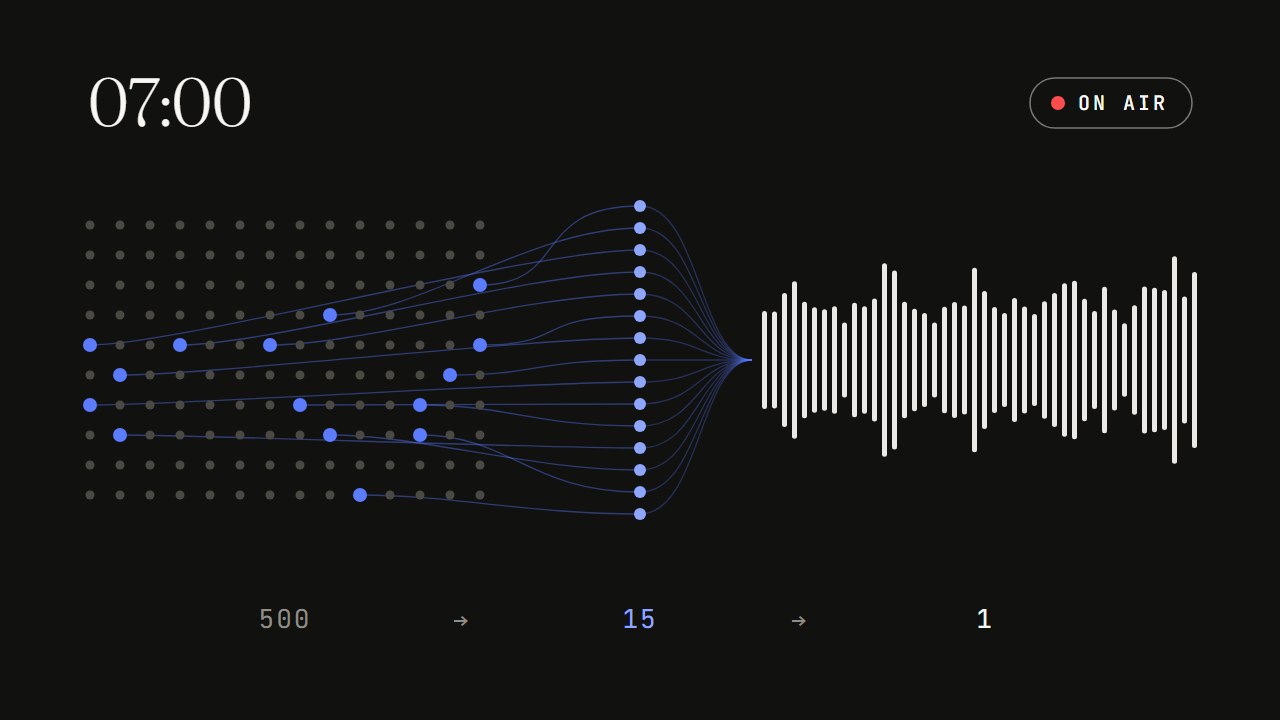
What comes out every morning
AI FinCast is an Italian-language podcast about markets: currencies, commodities, indices, crypto. It comes out Monday to Friday, early in the morning, and runs 14 to 15 minutes. On Saturday there is a recap of the week.
Every episode lands on Spotify, Apple Podcasts and YouTube, and has its own page with the transcript. The same material also becomes a LinkedIn post and a short video.
More than a hundred episodes have come out so far. I wrote, read or edited none of them. In the morning, when I wake up, the episode is already there.
It's not an AI making a podcast: it's a team of agents
The simplest idea is to ask one model: read today's news and write me an episode. It can be done. I saw it in the first months: half-hour episodes that kept circling the same two or three stories.
What works is splitting the job into roles, like in a newsroom. I call them agents for convenience: each has a single task, its own instructions and its own model.
- 01Pickssmall modelReads everything that came in and decides what matters today500 → 15 stories
- 02Writeslarge modelTurns the stories into the episode's sectionsa script, a bit long
- 03Cutslarge modelRereads everything and removes what isn't neededabout a fifth less
- 04Voicessynthetic voiceNarration and mixing14-15 minutes
- 05PublishescodeEpisode and page with the transcript3 channels
CODE · decides the order of the steps and checks every handoff
Two more roles work alongside the line: one goes deeper into the topic of the day, and one picks what is worth saying on LinkedIn and writes the post.
Not everything goes through a language model: the voice is synthetic, mixing and publishing are code. And code is also the piece that holds everything together, decides the order and checks that every step delivered what it was supposed to. It is not a model. The order of the steps must not be an opinion.
A different model for each task
Using the same model for everything is the convenient choice. It is usually also the wrong one: either you overpay for the simple tasks, or the hard ones come out badly.
| Task | Which model | Why |
|---|---|---|
| Picking the news | Small and fast (for example Claude Haiku) | It has to read a lot and decide quickly. It doesn't have to write well |
| Writing, cutting, going deeper | Large (for example Claude Sonnet) | Here the quality of the writing is the product |
| Picking the angle for the post | Small | It is a choice among a few options |
| Writing the post | Large | It goes out under my name |
| Fallback, in an emergency | Models from other providers, reached through OpenRouter (for example DeepSeek or Llama) | If the main provider doesn't answer. Today I switch it on by hand, and further down I explain why |
The bill: less than 25 US cents per episode, less than ten dollars a month, models only.
Two mistakes, and what they taught me
Forty days of the wrong news
At the end of August I rebuilt the role that picks the news. From that day, for forty days, it did something nobody saw: instead of returning the number of each story it had picked, it returned the story's position in its own ranking. One, two, three.
The result: episodes were built on the first stories in the list, the ones that happened to be at the top, each carrying the reasoning written for a different one. The episodes came out, they were well written, they talked about markets. They were just built on the wrong news.
Picked by the model
- 1
- 2
- 3 ✓
- 4
- 5 ✓
- 6
- 7
- 8 ✓
Ended up in the episode
- 1
- 2
- 3
- 4
- 5
- 6
- 7
- 8
There was a check, and it passed: it verified that the numbers returned were within the right range. They were. A check that looks at the form lets the worst failure through.
A number within range is a valid number, not the right number.
I found out by accident, from a question about cost: is it worth changing the model for this role? To answer, I replayed the picks of past days on the same data, and the numbers didn't add up. Today the check compares every pick with the story's headline.
Ten days written by the fallback
In those same days something else happened. I had moved the writing to a new model. That model no longer accepted a parameter the old one accepted, and it rejected every request. The system did what it was supposed to: it switched to the fallback, a smaller model, and the episode came out anyway.
It went on for ten days. Every morning my personal assistant reported the anomaly with the exact cause, and closed with a piece of advice: consider whether the quality is acceptable. A judgment call, in place of a configuration error.
The fallback had worked, and that is exactly the problem.
A fallback that works in silence hides the failure that triggered it.
Today I switch the fallback on myself, by hand, and a separate check tells me every morning which model wrote the episode.
It is the same family of mistakes I describe in My AI assistant was making up emails: nothing breaks visibly, and the result keeps arriving.
The one who writes doesn't cut
Until July the episodes ran half an hour. Too long, and you could hear it.
Asking the writer to be shorter didn't work. Separating the roles did: one writes aiming a bit longer than needed, another rereads and cuts about a fifth. And the length is no longer a fixed number: the day decides it. If little happens, the episode is shorter.
Today it runs 14 to 15 minutes. A single role, asked to write a lot and be brief, couldn't do it. Two roles can.
Where a person stays, and where the model doesn't decide
I don't step in on the episode. I step in at two points, and they are chosen.
- The LinkedIn post. An agent writes it, but it goes out under my name: it reaches my phone and is sent only if I approve it
- The short video. It is built automatically, with title and description. Uploading it stays with me, because YouTube keeps videos uploaded automatically by an unverified application locked as private
And there is one thing I let no model write: the legal disclaimer at the end of every episode. It is about money, and it has to be identical every time. Code attaches it, word for word.
What has to be exact you don't ask a model for: you write it once and paste it.
Four rules for orchestrating AI agents, beyond podcasts
- The task picks the model. First write down what that role has to do, then pick the smallest model that does it well
- A check looks at the content, not the form. That the answer has the right format doesn't say it is the right answer
- The fallback must announce itself. If it kicks in, you have to know that day, not ten days later
- Whoever produces is not whoever checks. Writing and cutting, picking and verifying: different roles. And where exactness is needed, the check is code
The podcast is just the case. The same pattern holds for a press review, a weekly report, a digest of customer requests: anywhere there is a lot to read, something to choose and a text to deliver every day.
If you are setting up something similar and want to compare notes, reach out.
Frequently asked questions
Can you create a podcast with AI?
Yes. The hard part is not generating an episode: it is generating a good one every day without having to look at it. One model is not enough for that. You need separate roles, checks on the content, and a person who decides what goes out under their name.
How much does an AI-generated podcast cost?
In my case less than 25 US cents per episode, less than ten dollars a month, models only. The real cost was the time it took to reach a result that doesn't need checking every morning.
Which AI model should you use for which task?
A small, fast model where there is a lot to read and a choice to make, a large one where the quality of the writing is the product. Start from the task, try the smallest model, and move up only if the result doesn't hold.
What is AI agent orchestration?
It is deciding who does what, in what order, with which model, and what gets checked between one step and the next. In my case the orchestrator is code and not a model: the order of the steps must not be an opinion.
Do you really need a multi-agent system?
No. You need one when a single task asks for conflicting things, like writing a lot and being brief, or reading a lot quickly and writing well. If the task is one, a single model with good instructions is enough.
Can an AI-made podcast be published on Spotify?
Mine has been on Spotify since May 2026 and on Apple Podcasts and YouTube since late August, and it says it is AI-made right in its name. Platform rules change: read them before you publish.

Holti Bitri
CTO & AI Innovator, TIG Factory. I design and lead workflows where AI agents and people build software together: written rules, a check at every step, human decisions. LinkedIn · holtibitri.com